
Designing a financial coach that earns the right to guide you.
Making financial context, uncertainty, and user control part of the product itself.
A little more clarity. A different kind of future.
FROM DAILY CHOICES TO LONG-TERM POSSIBILITY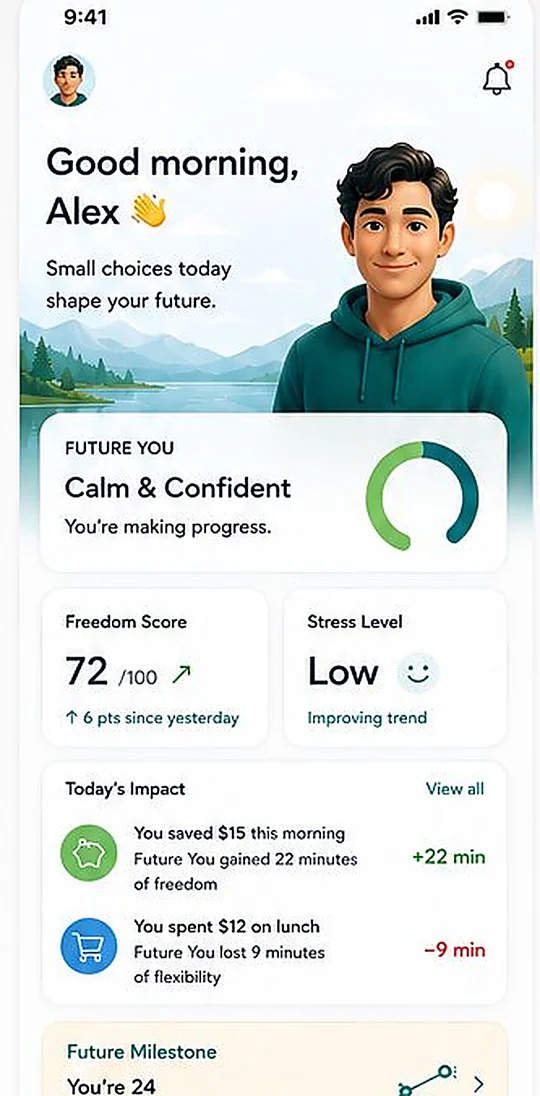
A financial question is also a question about trust.
- independent concept
- 0→1
- before advice
- Context
- by design
- Control
The problem worth solving
“Can I afford a $4,000 vacation?” sounds simple. A useful answer depends on what the product knows, what it cannot see, and which commitments the person wants to protect. A confident sentence without that context can be worse than no answer.
My mandate
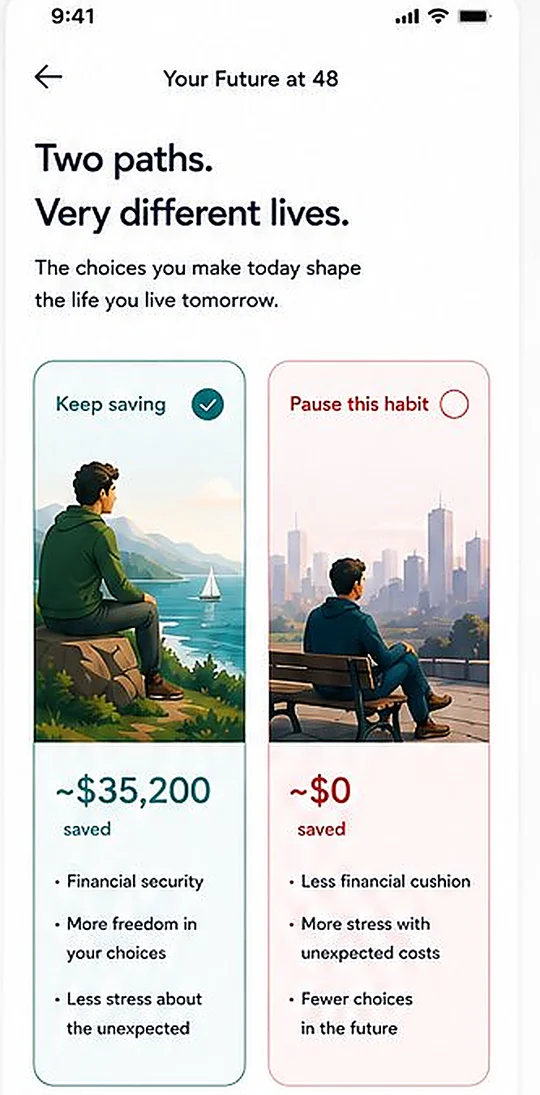
I created the Future You concept and its future-self, daily-impact, and scenario interfaces. The behavior prototype below is a new portfolio exploration: it uses fictional data and deterministic responses to make the proposed interaction concrete. It is not a connected banking product or a tested production AI system.
Draw the boundary before writing the answer.
- 01
User intent
Question + time horizon
- 02
Available context
Balances + commitments
- 03
Rules + permissions
No inferred missing accounts
- 04
Generation boundary
Explain; never invent amounts
- 05
Response + UI
Evidence + editable scenario
- 06
Evaluation
Grounding, caution, autonomy
Proposed product architecture. The generation boundary defines allowed inputs and outputs; it does not expose hidden model reasoning. Evaluation feeds the next design iteration.
Three decisions that changed the direction.
New behavior proposals, with validation still ahead.
Make missing context visible.
An answer should change when account information is incomplete. Silence about a missing account creates false certainty.
- ALTERNATIVE
- Give a yes/no answer from the visible balance alone.
- TRADEOFF
- A clarifying step adds friction before a useful response.
- RESULT
- Proposed behavior: withhold the affordability conclusion and ask the user to resolve missing commitments.
Keep arithmetic outside the model.
Balances, reserves, and subtraction are deterministic. Generated language can explain the result without owning the calculation.
- ALTERNATIVE
- Ask the model to calculate and narrate the whole answer.
- TRADEOFF
- More explicit product logic, with fewer opportunities for free-form answers.
- RESULT
- The working example recalculates from editable inputs and exposes the exact assumptions.
Let the conversation become an interface.
Comparing costs is easier with a structured scenario than repeated prompts. The next decision belongs to the user.
- ALTERNATIVE
- Keep every adjustment inside a chat thread.
- TRADEOFF
- A narrower interaction, intentionally focused on this decision.
- RESULT
- Proposed behavior: an editable trip cost and reserve sit beside the response and its evidence.
Make the answer inspectable.
Can I afford a
$4,000 vacation?
Before my next income, while protecting my reserve.
The original product exploration
The future-self concept explored daily impact and long-term habits. The new behavior prototype extends that question into financial context and uncertainty.
Future You original concept: future-self portrait and daily financial impact
How we knew.
The original project explored future-self portraits, daily habits, and editable projections. This new behavior direction has not been evaluated with a research cohort. The matrix below is a proposed evaluation rubric, not a claim about model performance.
ILLUSTRATIVE RESPONSES / PROPOSED RUBRIC
“With $1,800 committed and $3,000 protected, the $4,000 trip leaves $400. Are there other expenses before your next income?”
Stronger: shows the calculation, states its boundary, and asks about the information that could change the answer.
- Factual grounding
- Pass
- Financial context
- Pass
- Uncertainty
- Pass
- User autonomy
- Pass
Design revision: expose the reserve and commitments next to the answer, then ask for missing expenses. These are authored examples, not measured model outputs.
The leverage I left behind
An explicit boundary between calculation, context, and explanation. The proposed pattern makes missing data visible, keeps assumptions editable, and can be reused for other high-trust questions.
What to test next
Next validation: test whether people notice missing data, understand the protected reserve, and can explain why the answer changed. Evaluate comprehension and false confidence before testing how persuasive the coach feels.